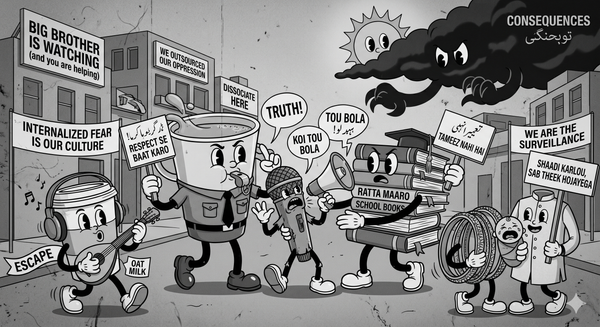
Standing on Opposite Sides of a Wall: The Argument Every Pakistani Family is Having

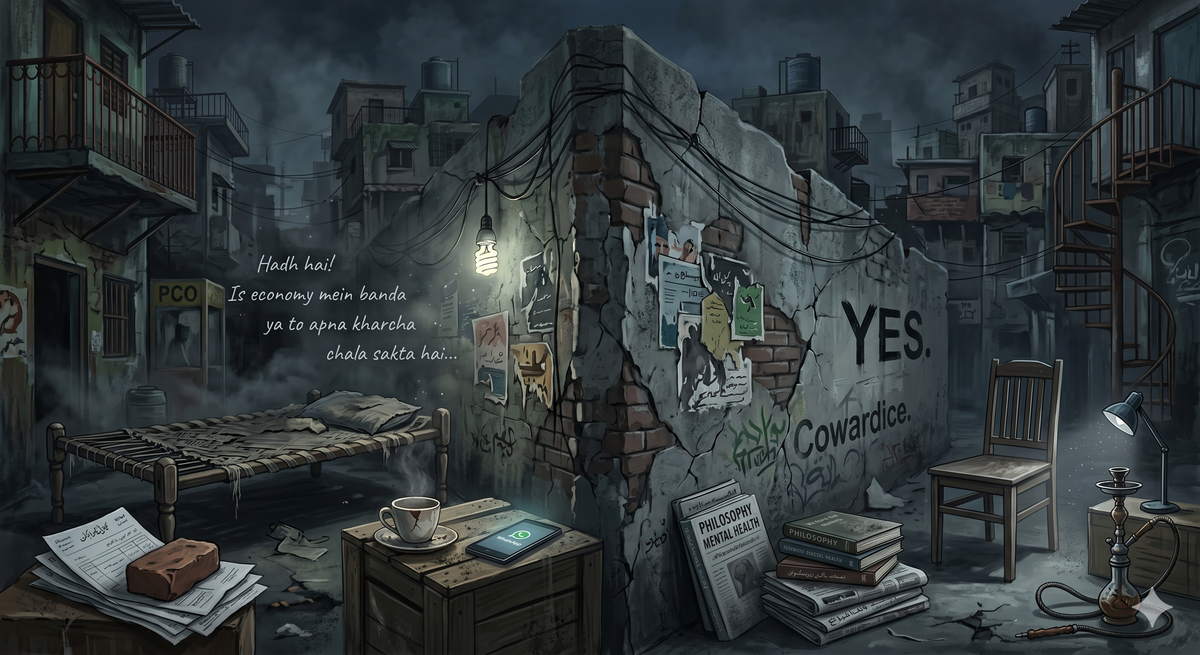
A conversation that went nowhere — and why that matters more than the answer
There is a particular kind of conversation that Pakistan runs on. It happens between friends, in drawing rooms, on late-night rooftop chats, in WhatsApp voice notes sent at 2 a.m. It is the conversation where someone finally says something true — and the other person responds with something equally true — and then both of them walk away exactly as they arrived.
No resolution. No movement. Just two people standing on opposite sides of a wall, each completely right, neither one wrong, and the wall still standing.
This is one of those conversations.
Two People, One Room, No Exit
It starts with a question that sounds like a joke but isn't.
"Hadh hai! Is economy mein banda ya to apna kharcha chala sakta hai ya apni mental health. Aur tum chah rahay ho ke main 'open' ho kar baatein karoon? Pese hain is sab ke liye?"
Translation:
"You plead me to be an emotionally regulated person, that is open and talks about their feelings? And is healing or healed? In this economy?"
We all have that one friend [Person 1] that says this. And if you've lived in Pakistan — not visited, not studied from abroad, not observed from a comfortable distance — you felt that in your chest before you even finished reading it. Because there is something so brutally accurate about attaching emotional health to economic survival, as if the two were in direct competition for the same limited resource inside a person.
To this reality, there also always will exist a friend [Person 2] that replies is a single word.
Yes.
And just like that a discourse amongst friends over chai, or family talk at the dinner table, starts; a battle line is drawn.
What follows is an argument that, on the surface, seems to be about men. But strip away the gendered framing and you find something older and harder underneath — a question about whether broken people are broken because of the world they inhabit, or whether they choose to stay broken once they've seen the exit.
Person 1 builds a careful, almost architectural case. They argue that the emotional damage most people carry isn't mysterious or metaphysical. It is structural. It comes from a society that evaluates worth almost entirely through utility — and mostly monetary utility. What you earn. What you provide. What you can deliver. Strip away those metrics and there is, for many people, nothing left. Not because they have no inner life, but because no one ever told them the inner life counted for anything.
And so they do what any rational creature does in an environment that rewards a specific behavior: they optimize for that behavior. They become the version of themselves that works. The provider. The earner. The person whose value is legible because it has a number next to it.
Person 2 listens and responds with something harder to dismiss: yes, but.
Yes, the system is broken. Yes, the pressures are real. But the people inside that system — the ones who know it is wrong, who can see the damage, who have the resources and sometimes even the desire to change — many of them don't. They stop at identification. They name the problem, describe it fluently, maybe even write about it online at 2 a.m. And then they go back to bed and nothing moves.
Person 2 calls this cowardice. Person 1 calls it survival. And here is where the conversation starts to eat itself.
The Social Tax of Getting Better
There is something Person 1 says that deserves to be read slowly.
"Agar main badal bhi jaoon, toh mujhe yeh dua karni paray gi ke mere aas paas ke log bhi thora 'emotionally stable' ho jayein aur apni nalaayikiyon ka ilzam mujh par na dalein. Agar main badla aur samaj ne mujhe reject kar diya, toh main akela reh jaoon ga. Aur agar main badal gaya aur un logon ko—jo chahte thay ke main badloon—yeh ehsas hua ke 'communication' toh asal mein ek bojh hai, toh woh mujhe istemal karne ka koi naya tareeqa nikaal lein ge."
Translation:
"If I change, I have to wish that the people around me also become emotionally regulated and don't blame me for their shortcomings. If I change and society discards me, I'm alone. If I change and the people who wanted me to change realize that communication is actually a 'burden,' they just find a new way to use me."
This is not self-pity dressed up as analysis. This is a real observation about how social systems respond to individuals who defect from the dominant code.
Think about what it actually means to become emotionally open in a context where emotional openness has no established social grammar. You are not just changing yourself. You are changing what you signal to the people around you. And the people around you — family, colleagues, partners, extended networks — were in a relationship with the previous version of you. They had expectations. They had arrangements. They knew what you were for.
When you change the terms, they don't automatically upgrade their understanding. Some will be confused. Some will be threatened. Some will, as Person 1 puts it, find a new way to use the new version of you — because use is the only relational mode they know.
And then there's the loneliest possibility of all: that you change, and you find yourself standing in a room full of people who haven't, and you are suddenly unable to speak their language anymore.
Pakistan is not unique in this. But it has specific textures that make the cost sharper. It is a country with deep family interdependence, where isolation isn't a lifestyle choice but a genuine catastrophe. Where mental health resources are either stigmatized, unaffordable, or simply absent in most cities outside of a few elite urban pockets. Where vulnerability in a person — regardless of gender — is frequently read not as courage but as weakness, and weakness invites exploitation.
Person 1 is not making an excuse. They are mapping the terrain. A realist.
The Problem With Calling It Cowardice
Person 2's argument has a clean, satisfying logic to it. People have agency. Change is possible. At some point, you stop being a victim of the system and start being a participant in it. Staying broken, when you have the ability to move, is a choice. And choices have moral weight.
There is truth in this. A real and important truth that cannot be dismissed just because it's uncomfortable.
But there is also a hidden assumption buried inside it — and it is the kind of assumption that looks neutral but isn't.
When Person 2 says
"they don't work towards getting better, even if they have the means to,"
they are drawing a clean line between those who can and those who can't, and placing moral condemnation only on the former. It sounds careful. But in practice, that line is almost impossible to draw cleanly.
One of the general replies to this conversation makes the point precisely:
"Some people can achieve significant change via self-realization without outside assistance. But it's not clear how many."
And then it lists the complicating factors. The elderly who are working against a lifetime of contrary psychological habits. The people in poverty for whom abstract self-realization competes with concrete hunger. The ones in environments that actively punish emotional awareness — where alexithymia isn't a disorder but an adaptation. The people carrying histories of violence so total that not feeling things was literally how they survived.
To look at all of that and say cowardice is not analysis. It is frustration wearing the costume of analysis.
And frustration, however understandable, is not useful here. Because the person you are calling a coward is the same person you want to convince. And you cannot convince someone by condemning them. You can only make them defend themselves. Which is exactly what happens.
Ironically, Person 2 — who wants emotional openness — responds to its absence with judgment. Wants vulnerability but reaches for contempt. Wants accountability but offers shame. This is not a contradiction unique to Person 2. It is a contradiction nearly everyone shares when they care deeply about something and watch it fail repeatedly. The anger is legitimate. The method is self-defeating.
The Addiction Metaphor and What It Actually Means
Midway through the conversation, Person 1 reaches for a comparison.
"Going forward with 'fixing' the problem is like asking an addict to stop drinking."
Person 2 pushes back immediately: "Rehabilitation isn't just 'asking an addict to stop drinking.'"
They're both right. But they're talking about different things.
Person 1 is making a point about dependency — about what happens when the only way someone has ever been loved, respected, or seen is contingent on what they provide. The substance in this metaphor isn't alcohol. It is the conditional love itself. The approval that comes with performance. The identity that was assembled entirely from external validation.
When the only feedback loop you've ever had tells you that your worth is your output, then asking you to decouple worth from output isn't just asking you to change a habit. It is asking you to step off a ledge without knowing whether the ground is there.
Person 2 is right that rehabilitation is more than willpower. But the version of rehabilitation that exists in most of Pakistan — peer support, accessible therapy, family systems willing to hold someone through change — is largely theoretical. It exists in pockets. For most people, the infrastructure isn't there.
What replaces it? The conversation doesn't say. And that gap is the most honest thing about it.
The Policeman Problem
Near the end, Person 1 offers a scenario that is both a metaphor and a confession.
A policeman is beating someone for refusing to pay a bribe. You are watching.
Option one: you step in. You get beaten, or stopped from doing other good.
Option two: you stand in the back and say "brother, that's enough" — present but not intervening, a witness but not a martyr.
From the victim's perspective, Person 1 says, you are either a sacrifice or you are evil. There is no third reading where you are simply a person who weighed the cost and found it too high.
And then the question that ends the conversation:
"Which one would you choose?"
Usually the conversation ends here. Person 2 never replies, and this incredibly sensitive, topic is left discarded, to repeat unto itself again and again.
It's tempting to read that silence as capitulation — as if Person 1 finally said something so perfectly constructed that there was no counter available. But that's probably not what happened. What more likely happened is that Person 2 reached the same place everyone reaches when this conversation runs long enough: the place where you realize that both options are bad, both positions are partial, and the real answer requires something neither person in a two-person conversation can build alone.
The Third Person in the Room
One of the replies to this conversation introduces something unsettling.
It describes a third person. One who isn't Person 1 or Person 2. One who is watching both of them talk and smiling — not because they're amused, but because the conversation itself is already contained. Because one person will never challenge the structure, and the other is already operating inside it, trading in the same currencies of money and dominance, just calling it by different names.
This third person doesn't argue. They demonstrate. They don't need to win a debate because they are already winning the material conditions. And both Person 1 and Person 2, for all their clarity and frustration, are having a conversation that this third person has already accounted for.
This is uncomfortable to sit with. It suggests that the debate between systemic entrapment and personal accountability might itself be a kind of trap — a loop that keeps the focus on individuals while the structural conditions remain unaddressed, untouched, and extremely profitable for certain people.
It doesn't mean the conversation is useless. It means the conversation is incomplete.
What Binary Thinking Costs Us
The problem with the Person 1 / Person 2 framing — and it is a framing that most of Pakistan runs on, not just these two people — is that it presents exactly two options:
The system is to blame, and the individual is a product of it.
Or the individual is responsible, and the system is an excuse.
These are not two sides of a balanced argument. They are two incomplete halves of something more complex than either frame can hold.
Because here is what is true simultaneously:
The system in Pakistan — the economic precarity, the conditional love, the stigmatization of vulnerability, the absence of mental health infrastructure, the deep conflation of human worth with financial productivity — is real. It is not imagined by the people it damages. It is not a personal narrative. It is a structural reality that takes specific, documentable forms. You can trace it in school curricula, in wedding negotiations, in the way certain phrases operate as normal social currency — kitna kamata hai, kya karta hai — what does he earn, what does he do. You can trace it in the way that emotional self-disclosure between people, particularly between men, is so often interrupted, deflected, or met with advice instead of presence.
And also:
The people inside that system are not passive. They make decisions. They act. They sometimes stay inside patterns they could leave, because leaving is hard and staying is familiar and the cost-benefit is genuinely unclear. Some of them use the system as cover for behavior they could change. Some of them have internalized their own oppression so thoroughly that they have become its most ardent defenders. Some of them are simply exhausted and have nothing left to give the project of self-reconstruction.
Both of these things are true at once. The system is real. Agency is real. Neither one cancels the other.
But we keep talking about them as if they do.
Why This Conversation Keeps Happening
If you have lived in any Pakistani city long enough, you have had a version of this conversation. Maybe with different stakes, different vocabulary, different specific grievances. But the shape is the same.
Someone describes the structural constraints on their life with precision and despair.
Someone else responds that the constraints do not excuse the choices.
Someone talks about the cost of change.
Someone else talks about the cowardice of staying still.
And then it ends. Not because a conclusion was reached, but because the emotional bandwidth ran out. Because it is late. Because someone has work tomorrow, or a family obligation, or simply because the conversation got too heavy and the only way out was silence.
These conversations are not failures. They are symptoms of something real trying to get said.
What is trying to get said — underneath the debate about systems and accountability — is something like this:
I am living inside a set of conditions I did not choose, and the conditions are damaging me, and I do not know how much of what I do is the damage and how much is me, and I am afraid that if I try to find out, I will lose everything I have built on top of not knowing.
That is not a cowardly statement. That is an honest one.
And it might be the most important thing either person in this conversation never quite managed to say.
The Question Nobody Asked
None of the participants — not Person 1, not Person 2, not the people who replied — asked the question that might actually matter.
Not who is right.
Not what should be done.
But: what would it take for this to be different?
Not for one person, in isolation, through sheer force of will. But structurally. Materially. What would it actually require?
It would require mental health services that are accessible and affordable, not just to the upper-middle class in Karachi, Lahore, and Islamabad, but to the people in Hyderabad, Larkana, Quetta, Peshawar, in the small cities and the towns in between where the question of therapy doesn't even register as a real option because no one in the immediate environment has ever had it.
It would require educational spaces where emotional vocabulary is taught, not as a luxury or a Western import, but as a basic human skill — the same way we teach children to read and count, we could teach them to name what they feel and sit with what others feel.
It would require family systems willing to revise their own inherited contracts — which is perhaps the hardest thing on this list, because family systems in Pakistan are not just personal. They are financial. They are economic. They are deeply entangled with survival in a context where the state provides almost nothing, and family is the only safety net most people have.
It would require a slower, less binary public conversation — one that can hold the complexity of the system is real and you still have choices without collapsing either side to defeat the other.
None of this is impossible. All of it is slow.
What The Silence at the End Means
Person 2 never replied.
It would be easy to read that silence as defeat — as if Person 1's final question about the policeman was unanswerable, and the silence was an admission. But silence at the end of a hard conversation is rarely just one thing.
Sometimes silence is exhaustion. Sometimes it is thought. Sometimes it is the recognition that the conversation has arrived somewhere real and neither person knows what to do with it.
Person 1 asked: which would you choose?
And the honest answer is that most of us, in most moments, choose option two. We stand in the back. We say brother, that's enough. We are present but not intervening. We know the thing is wrong and we say so softly and we do not put our body in front of it.
Not because we are evil. Not because we are cowards. But because we are people — with families, with jobs, with exhausted hearts, with a calculation running constantly in the background about what we can afford to lose.
The question is not whether that is good enough. We already know the answer to that.
The question is what it would mean to live in a society where the cost of being better was low enough that more people could afford to pay it.
That is not a question about personal accountability. That is not a question about systemic determinism. It is a question about what kind of world we are building — slowly, together, whether we intend to or not.
Both Person 1 and Person 2 are building it. So is the third person watching from the corner.
So are we.
This piece reflects on a real online conversation and the broader social dynamics it represents. The participants are identified only as Person 1 and Person 2. Their words have been reproduced here to describe a common experience, not to adjudicate it.